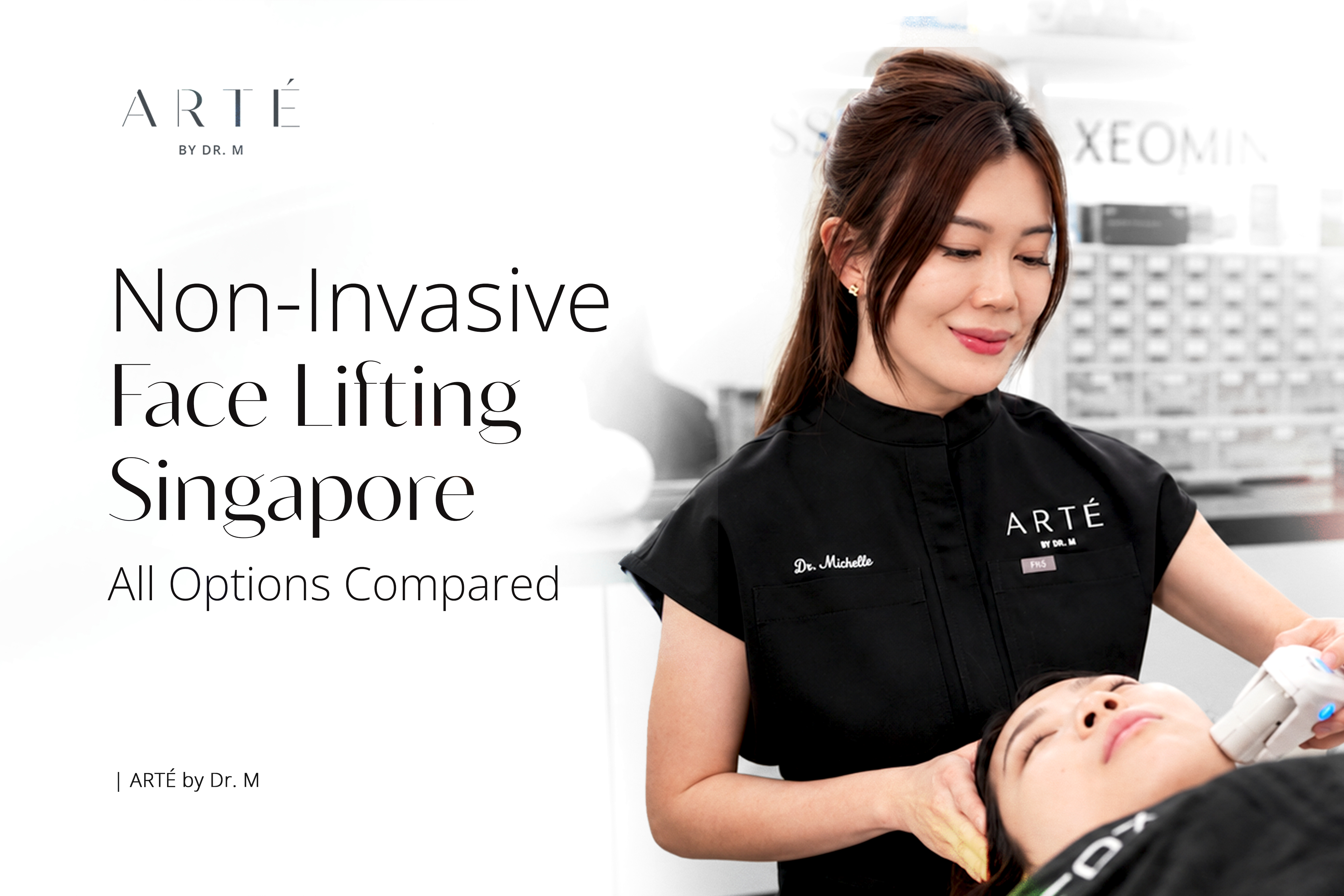
The number of non-invasive face lifting options available in Singapore has grown significantly over the past decade. That is good news for patients who want to address skin laxity without surgery. But it also means more confusion.
Every clinic promotes its device as the ideal solution. Marketing language blurs the lines between technologies that work very differently. And patients are left comparing options without understanding what actually distinguishes one from another.
This guide breaks down the major non-invasive and minimally invasive face lifting technologies available in Singapore: what each does, how deep it goes, what it treats, and how to decide which one fits your specific situation.
Understanding the Basics: How Non-Invasive Lifting Works
All non-invasive lifting technologies share a common principle: they deliver controlled energy into the skin to stimulate a biological response primarily collagen remodelling and tissue tightening.
Where they differ:
- Type of energy: ultrasound, radiofrequency, or mechanical
- Depth of penetration: surface, mid-dermis, deep dermis, or SMAS layer
- Mechanism: focused vs. diffuse, single-depth vs. multi-depth
- What they treat: fine lines, texture, mild laxity, moderate laxity, or structural sagging
No single technology addresses every concern at every depth. Understanding this is the first step toward making a good decision.
The Major Non-Invasive Lifting Technologies
1. Ultherapy Prime (Micro-Focused Ultrasound with Visualisation)
How it works: Delivers focused ultrasound energy to precise depths, creating thermal coagulation points that trigger new collagen and elastin production. Includes real-time ultrasound imaging so the doctor can visualise tissue layers during treatment.
Depths: 1.5mm (superficial dermis), 3.0mm (deep dermis), 4.5mm (SMAS layer)
What it treats:
- Moderate skin laxity jawline, jowls, neck
- Brow heaviness and sagging
- Décolletage lines
- Overall structural loss in the midface
Key differentiators:
- Only non-invasive device FDA-cleared for lifting
- Reaches the SMAS layer the deepest target available without surgery
- Real-time visualisation allows precise, anatomy-guided treatment
- Multi-depth capability in a single session
Results timeline: 3–6 months (progressive collagen remodelling) Sessions: Typically 1 session; maintenance at 12–18 months Downtime: None to minimal (mild redness, tenderness)
Ideal for: Patients with moderate laxity who want the deepest non-invasive lifting option, particularly along the lower face and neck.
Related: Ultherapy Prime Treatment: Is It All the Same? Why Your Doctor Matters Why the operator matters as much as the device.
2. Sofwave (SUPERB Ultrasound Technology)
How it works: Uses Synchronous Ultrasound Parallel Beam (SUPERB) technology to deliver ultrasound energy to the mid-dermis. Integrated cooling (Sofcool) protects the skin surface.
Depth: ~1.5mm (mid-dermis)
What it treats:
- Fine lines and superficial wrinkles
- Mild skin laxity
- Skin texture and surface firmness
- Eyebrow lifting (FDA-cleared)
Key differentiators:
- Single-depth treatment focused on the mid-dermis
- Does not reach the SMAS layer
- No real-time visualisation
- Generally shorter treatment time and milder sensation
Results timeline: 1–3 months Sessions: 1 session; some patients repeat Downtime: Minimal
Ideal for: Patients with fine lines and mild laxity who do not need deep structural lifting.
Related: Ultherapy Prime vs. Sofwave: Differences, Benefits, and Why Some Patients Combine Both. When and why you might combine both.
3. HIFU (High-Intensity Focused Ultrasound) Generic Devices
How it works: Uses focused ultrasound energy to target specific skin depths. HIFU is a broad category multiple manufacturers produce HIFU devices with varying specifications, quality controls, and clinical evidence.
Depths: Varies by device (typically 1.5mm, 3.0mm, and sometimes 4.5mm)
What it treats:
- Mild to moderate skin laxity
- Facial contouring
- Jawline and double chin
Important distinction: HIFU is a technology category, not a single device. The term covers everything from premium medical-grade systems to lower-cost devices with less clinical validation. Not all HIFU devices are equivalent in energy precision, safety features, or clinical evidence.
Ultherapy Prime is technically a form of HIFU, but with specific differentiators: micro-focused energy delivery, real-time visualisation, multi-depth transducers, and extensive clinical research backing its FDA clearance.
Results timeline: 2–6 months Sessions: 1–3 sessions depending on device and protocol Downtime: None to minimal
Ideal for: Patients seeking ultrasound-based tightening. However, due to the wide range of devices in this category, outcomes and safety profiles vary significantly. Ask which specific device is being used and what clinical evidence supports it.
4. RF Microneedling (Radiofrequency + Microneedling)
How it works: Combines tiny needles that penetrate the skin with radiofrequency energy delivered through the needle tips. The needles create micro-channels while RF energy heats the dermis at controlled depths.
Depths: 0.5mm–3.5mm (adjustable based on needle depth)
What it treats:
- Skin texture and pores
- Acne scarring
- Fine lines
- Mild to moderate skin laxity
- Overall skin quality improvement
Key differentiators:
- Dual mechanism physical (needles) + thermal (RF)
- Adjustable depth per treatment area
- Addresses both texture and mild tightening
- Versatile can be used on face and body
Results timeline: 1–3 months per session; cumulative improvement over a series Sessions: 3–4 sessions, spaced 4–6 weeks apart Downtime: 1–3 days of redness, mild swelling, pin-point marks
Ideal for: Patients whose primary concern is skin texture, pores, or scarring, with a secondary interest in mild tightening. Not a standalone solution for moderate to significant laxity.
5. Thread Lift (PDO, PCL, or PLLA Threads)
How it works: Dissolvable threads are inserted under the skin using a needle or cannula. Barbed threads provide an immediate mechanical lift. Over time, the threads dissolve and stimulate collagen production along their path.
Depths: Subdermal (beneath the skin surface)
What it treats:
- Mild to moderate sagging midface, jawline, jowls
- Nasolabial folds
- Marionette lines
- Brow lifting
Key differentiators:
- Only minimally invasive option on this list (involves needle insertion)
- Provides the most immediately visible lift
- Results are partly mechanical (the threads physically hold tissue up) and partly biological (collagen stimulation)
- Thread type matters PDO threads dissolve in ~6 months, PCL/PLLA threads last longer
Results timeline: Immediate lift visible; collagen effects develop over 2–3 months Sessions: 1 session; maintenance varies Downtime: 3–7 days of swelling, bruising, tenderness; restrictions on facial movements initially
Ideal for: Patients who want an immediate visible lift and are comfortable with a minimally invasive procedure. Not a replacement for surgery in cases of significant laxity.
6. XERF (Radiofrequency)
How it works: Uses controlled radiofrequency energy to heat the dermal and subdermal layers, causing collagen contraction and stimulating new collagen production.
Depths: Dermis and superficial subdermal layer
What it treats:
- Surface skin tightening
- Skin texture improvement
- Fine lines
- Mild laxity at the surface level
Key differentiators:
- RF-based different energy mechanism from ultrasound
- Targets shallower layers than Ultherapy Prime
- Volumetric heating for even energy distribution
- Often used in combination with deeper treatments for comprehensive results
Results timeline: 1–3 months Sessions: 1–3 sessions depending on protocol Downtime: Minimal
Ideal for: Patients seeking surface-level tightening and texture improvement, particularly as a complement to deeper treatments.
Related: Ultherapy Prime or XERF? Why Some Skin Concerns May Benefit From Both — the multi-layer approach explained.
Comparison Table: All Technologies at a Glance
How to Choose: The Questions That Actually Matter
Instead of asking "Which device is the right one?" which leads to device-centric marketing — ask these questions:
1. What Is My Primary Concern?
- Deep sagging and structural loss (jawline, jowls, neck) → Technologies that reach the SMAS layer (Ultherapy Prime)
- Fine lines and surface texture → Shallower technologies (Sofwave, RF microneedling)
- Combination of both → Multi-treatment approach
- Immediate visible lift → Thread lift
- Scarring or pore concerns → RF microneedling
2. How Severe Is My Laxity?
- Mild: Most single technologies can help
- Moderate: Deeper-reaching devices (Ultherapy Prime) or combinations are more appropriate
- Severe: Non-invasive treatments have limitations. An honest doctor will tell you when surgery would deliver a more appropriate result
3. What Downtime Can I Accommodate?
- Zero downtime: Ultherapy Prime, Sofwave, XERF
- Minimal (1–3 days): RF microneedling
- Moderate (3–7 days): Thread lift
4. What Is My Budget and What Provides Genuine Value?
Price varies significantly across technologies and clinics. But the lowest price is rarely the right selection criterion. Consider:
- One well-executed session of the right treatment outperforms multiple sessions of the wrong one
- A doctor who performs fewer, more precise treatments saves you money long-term compared to a clinic that sells you a package of many sessions
- Ask what is included assessment, follow-up, and realistic expectation setting are part of the value, not just the device time
5. Who Is Performing the Treatment?
This may be the most important question on this list. The same device produces different results depending on:
- The operator's training and experience
- Whether they customise the treatment or use a template
- Whether they actively use device features (like visualisation)
- Their anatomical knowledge and ability to adapt in real time
A skilled doctor with a good device will outperform an average operator with a premium device. Every time.
What You Should Ask During a Consultation
Go into your consultation with these questions:
- "Which specific device do you use, and what clinical evidence supports it?" This filters out generic claims.
- "Will the doctor perform the treatment, or will it be delegated?" Doctor-led treatments tend to produce more consistent results for complex devices.
- "How will you determine which treatment is right for me?" The answer should involve an assessment of your skin, not a pre-set recommendation.
- "What can this treatment realistically achieve for my level of laxity?" An honest answer builds trust. Overpromising is a red flag.
- "How many of these treatments do you perform per month?" Volume and experience correlate with outcomes for operator-dependent devices.
- "What happens if I am not satisfied with the results?" A good clinic has a follow-up protocol, not a disclaimer.
Why the Operator Matters as Much as the Device
We have covered this point in the technology sections, but it deserves its own emphasis.
Non-invasive lifting devices, particularly operator-dependent ones like Ultherapy Prime are not plug-and-play. The variables a skilled operator controls include:
- Energy parameters per treatment zone
- Depth and transducer selection
- Real-time adjustments based on tissue response
- Treatment area prioritisation
- Knowing when to combine technologies and when one is sufficient
A doctor who understands multiple modalities can recommend based on your anatomy rather than defaulting to whatever device the clinic owns. This is the difference between device-driven clinics and doctor-driven clinics.
Dr. Michelle Ng: Merz Trainer for Ultherapy Prime and Merz Injectables
Dr. Michelle holds dual trainer certification from Merz Aesthetics appointed as a Merz Trainer for both Ultherapy Prime and Merz Injectables (dermal fillers and neurotoxins).
What this means for your treatment:
- She trains other doctors on Ultherapy Prime from patient selection and treatment planning to parameter optimisation and technique
- Dual modality expertise understanding both device-based lifting and injectable-based facial rejuvenation gives her a broader perspective on what your face actually needs
- Anatomy-first approach she does not default to one treatment. The recommendation follows the assessment, shaped by her understanding of how different modalities interact
At ARTÉ, Dr. Michelle personally performs every treatment. There is no delegation to therapists or assistants for device-based or injectable procedures. The doctor who assesses you is the one who treats you.
This approach limits the number of patients the clinic can see per day. That is by design. It means each patient gets the time and attention that complex treatments require.
Combination Approaches: When Multiple Technologies Make Sense
Many patients benefit from combining technologies not because more is always better, but because different concerns exist at different depths.
Common combination strategies:
The key principle: combinations should be designed based on your assessment, not sold as a standard package. If a clinic recommends a combination before examining your skin, question why.
What About Surgical Facelifts?
Non-invasive treatments are not surgical replacements. They occupy a different part of the spectrum:
An honest practitioner will tell you when non-invasive options can deliver meaningful improvement and when they cannot. If your laxity is beyond what these technologies can address, the right recommendation may be a surgical consultation with a plastic surgeon, not a more aggressive non-invasive treatment.
Frequently Asked Questions
Start with an Assessment, Not a Device
The right non-invasive lifting treatment for you depends on your anatomy, the severity and location of your concerns, your timeline, your comfort with downtime, and your realistic expectations.
The decision should never start with "Which device should I get?" It should start with "What does my skin actually need?"
That is what a proper consultation determines. Dr. Michelle will assess your face, discuss your goals, explain what is achievable, and recommend a plan that fits whether that involves one treatment, a combination, or sometimes the honest recommendation that non-invasive options are not sufficient for your particular situation.
Book a consultation at ARTÉ by Dr. M Millenia Walk, 9 Raffles Blvd, #02-42, Singapore 039596 (+65) 8206 8869 | hello@artebym.com
----------------------------------------------------------------------------------------------------------------------------------------------------------------------------------------------------------------------------------------
This article is written by Dr. Michelle Ng (MBBS (Singapore)), Merz Certified Trainer for Ultherapy Prime and Merz Injectables, and founder of ARTÉ by Dr. M. All treatments at ARTÉ are performed personally by Dr. Michelle or Dr. Alfred who is personally trained by Dr. Michelle.
Disclaimer: Individual results vary. All treatments carry potential risks and side effects. A consultation with a qualified medical professional is recommended before undergoing any aesthetic procedure.